About Quai Network
Proof-of-Work Blockchain with 255,000+ TPS
Quai is a next-generation blockchain that merges the security of Proof-of-Work with unprecedented scalability. Two native tokens complete the system: QUAI, a deflationary store of value like digital gold, and QI, the world’s first decentralized currency backed by real energy cost.
The Problem with Money
The U.S. dollar has lost over 97% of its purchasing power since the Federal Reserve was established in 1913. In August 1971, President Nixon ended the dollar’s convertibility to gold, removing the last constraint on monetary expansion.
Since then, global debt has surpassed $300 trillion. Central banks normalize emergency measures — zero interest rates, quantitative easing, yield curve control — that erode purchasing power and reward borrowing over saving.
Why centralized stablecoins aren’t the answer
Centralized stablecoins like USDT and USDC depend on banking relationships that regulators can sever at will. Circle froze funds at the U.S. Treasury’s direction. Tether faces continuous regulatory pressure. A stablecoin that can be frozen is not stable — it is permissioned.
Even dollar-pegged stablecoins inherit the inflation of the dollar itself. They replicate the fiat system on-chain rather than replacing it.
Why Bitcoin alone isn’t enough
Bitcoin proved that a decentralized, energy-secured ledger was possible. But its single chain cannot scale beyond ~7 TPS, and its single token cannot serve as both a stable medium of exchange and a scarce store of value.
Quai builds on Bitcoin’s foundation — Proof-of-Work, UTXO transactions, energy-backed scarcity — and solves the problems that kept it at proof-of-concept scale.
Two Tokens, One Monetary System
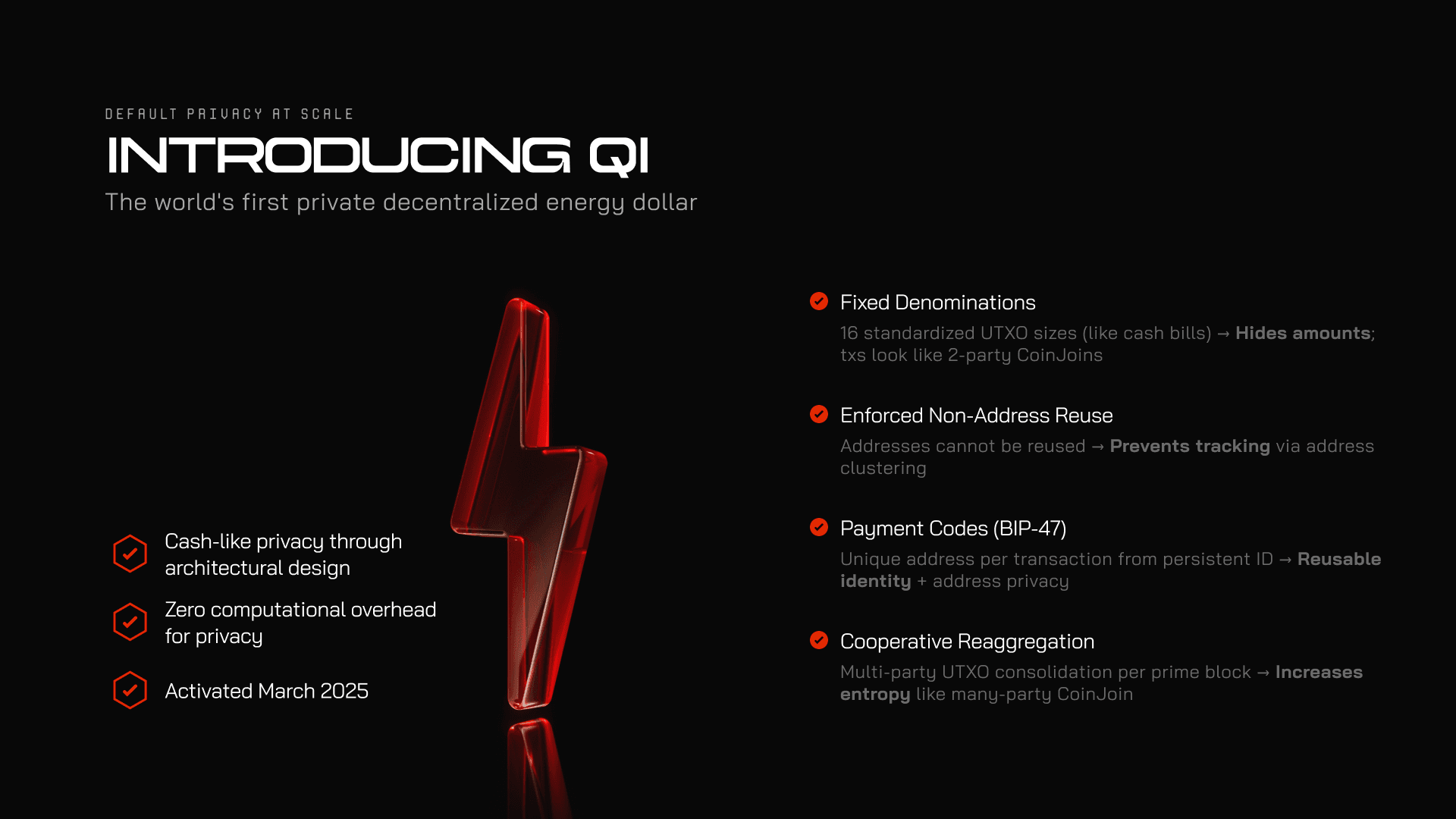
Money needs to do two things that are fundamentally in tension: hold value over time, and flow freely as a medium of exchange. Quai is the first protocol to solve both with two native tokens.
QUAI
Store of Value
- EVM-compatible, account-based
- Logarithmic emission — increasingly scarce
- Powers smart contracts and DeFi
- Soft cap ~1.4B after Singularity Fork
QI
Medium of Exchange
- UTXO-based with Schnorr signatures
- Linear emission — tracks energy cost
- Decentralized, energy-backed stability
- Privacy-preserving transactions
Miners choose which token to receive as their block reward. Anyone can convert between QUAI and QI at the protocol-set rate by burning one to mint the other. This creates a self-regulating monetary system — when QI trades above energy cost, supply expands until price falls; when below, holders convert to QUAI, contracting QI supply until price rises.
How the on-chain controller maintains equilibrium
The QUAI/QI exchange rate is not set by an oracle, DAO vote, or market maker. An on-chain controller observes miner token choices over a rolling 4,000-block window and adjusts the rate using a logistic regression model (the K-Quai controller) with an alpha parameter of 1/1000.
A cubic discount function prevents arbitrage: every conversion incurs a minimum 20 basis point slip, with penalties scaling cubically as volume rises relative to the network average. The result is a monetary system that self-corrects in real time — no emergency rate cuts, no quantitative easing, no bailouts.
Why Qi is an “energy dollar” — not a stablecoin
Qi is not pegged to the dollar. It is anchored to the cost of energy. QI emissions are linearly proportional to mining difficulty, which is a direct function of total energy expenditure. Each unit of QI represents a roughly constant amount of real-world energy.
This makes QI a flatcoin — stable against thermodynamic cost rather than an arbitrary fiat denomination. Under the hood, QI uses the UTXO model (like Bitcoin) with Schnorr signatures and minimal programmability. A medium of exchange should be fast, private, and simple.
The Architecture
Quai organizes its network into a three-level hierarchy secured by merged mining. Every miner simultaneously mines all levels — a single hash is checked against Prime, Region, and Zone difficulty thresholds. No extra energy, no extra hardware.
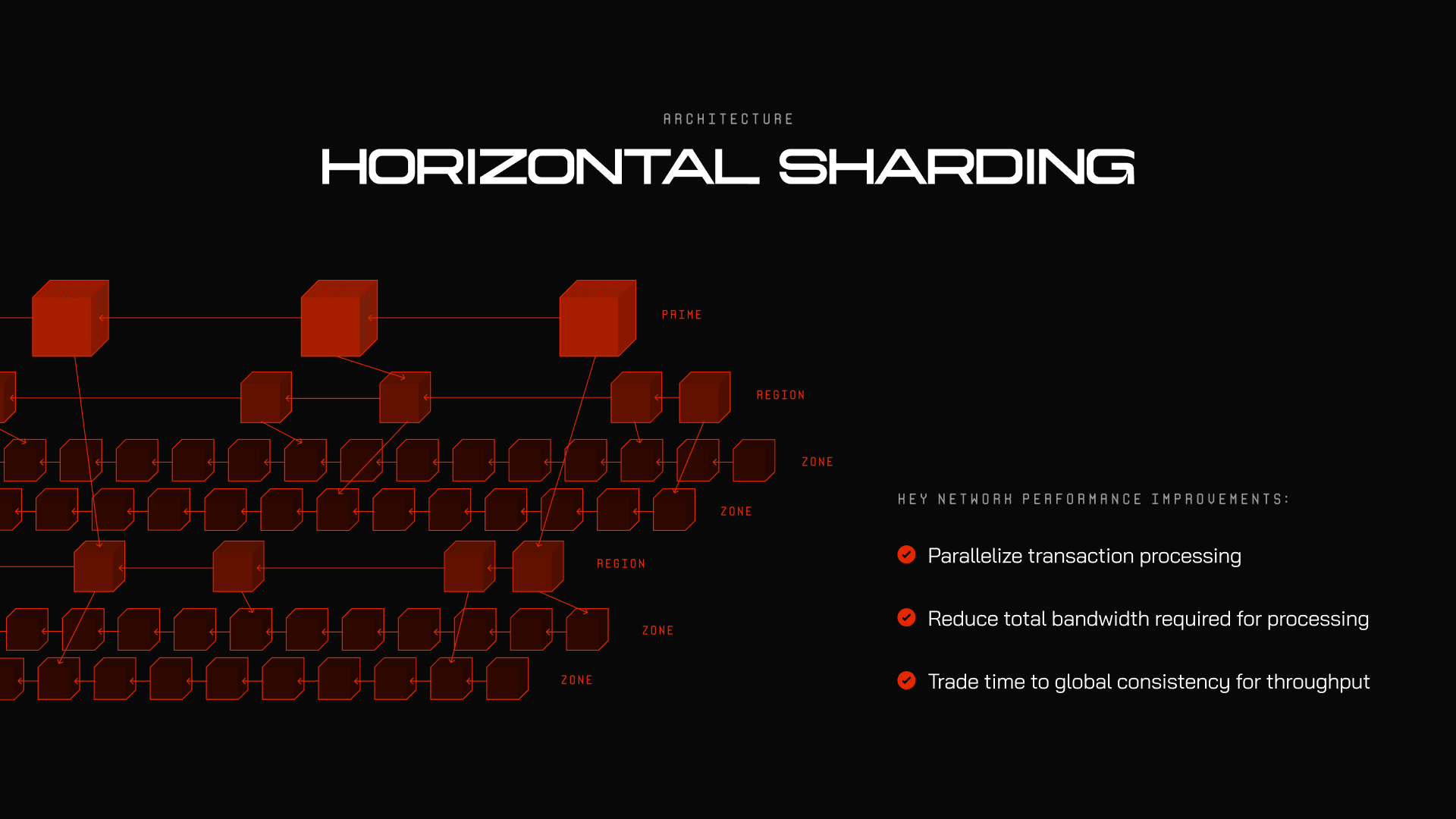 The Quai hierarchy — Prime, Region, and Zone chains, all merged-mined. The network starts small and expands automatically as demand grows.
When a miner’s hash meets the difficulty threshold of multiple levels simultaneously, a coincident block is created — valid in both chains, forming a trustless bridge. A 51% attack on any single zone requires controlling 51% of the entire network’s hashpower.
How Proof of Entropy Minima (PoEM) achieves instant consensus
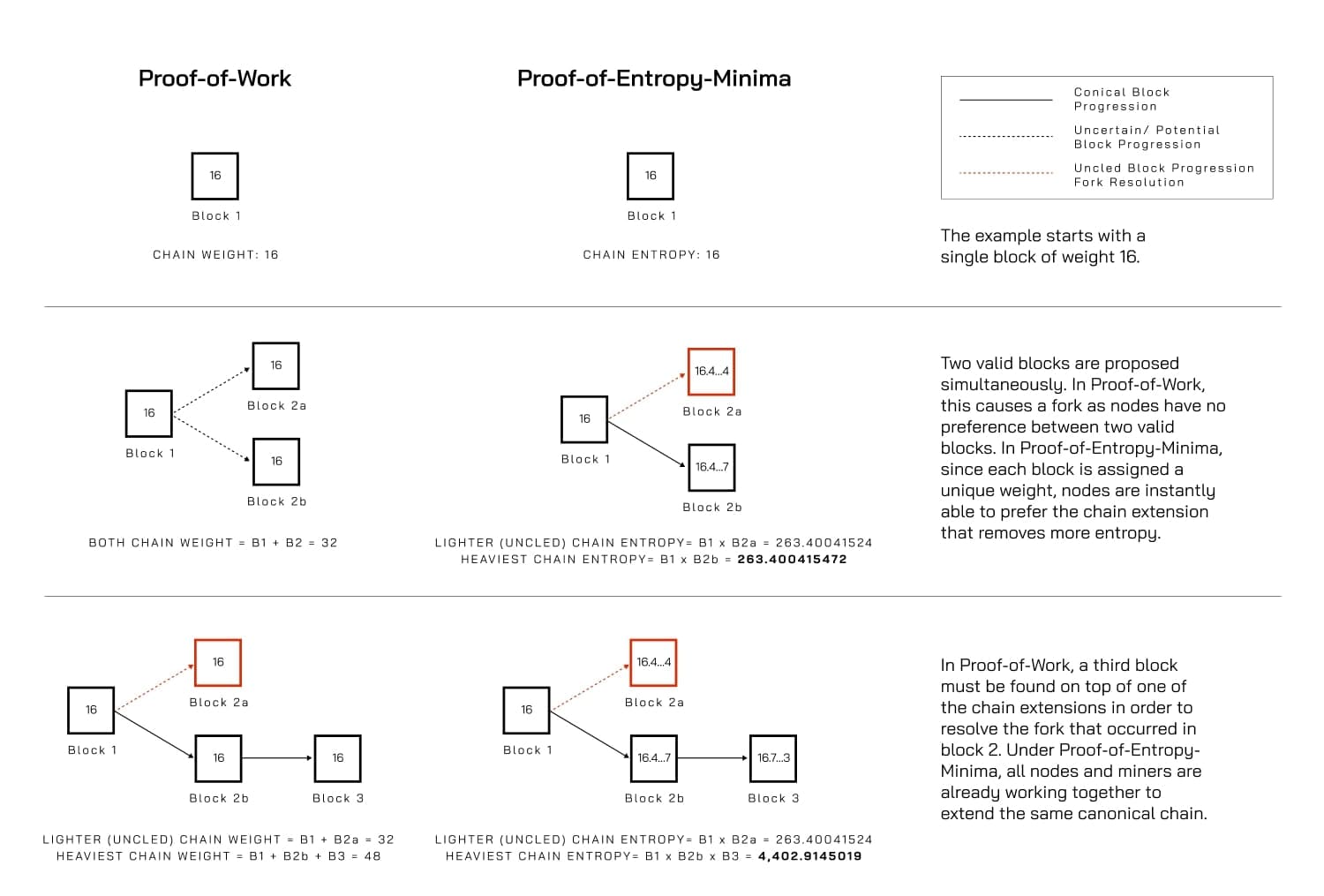
Traditional blockchains fork when two miners find a block at the same time. Quai’s consensus mechanism, PoEM, measures the intrinsic entropy each block removes from the hash space. Every node always picks the same winner — no forks, no ambiguity, no wasted work. Consensus is instant and objective.
PoEM also eliminates selfish mining incentives. Because the block with the lowest entropy always wins, a withheld block loses to any published block that achieves lower entropy during the withholding period.
Cross-chain transactions and coincident blocks
When a miner produces a hash that meets the difficulty threshold of both a Zone and its parent Region (or Region and Prime), the resulting block is a coincident block — simultaneously valid in multiple chains.
Coincident blocks create deterministic, trustless bridges between chains. Cross-chain transactions are atomic: they either execute fully across all involved chains, or not at all. Settlement takes ~30 seconds versus days for traditional L2 bridges.
Watch: How Quai Works
Project SOAP & the Singularity Fork
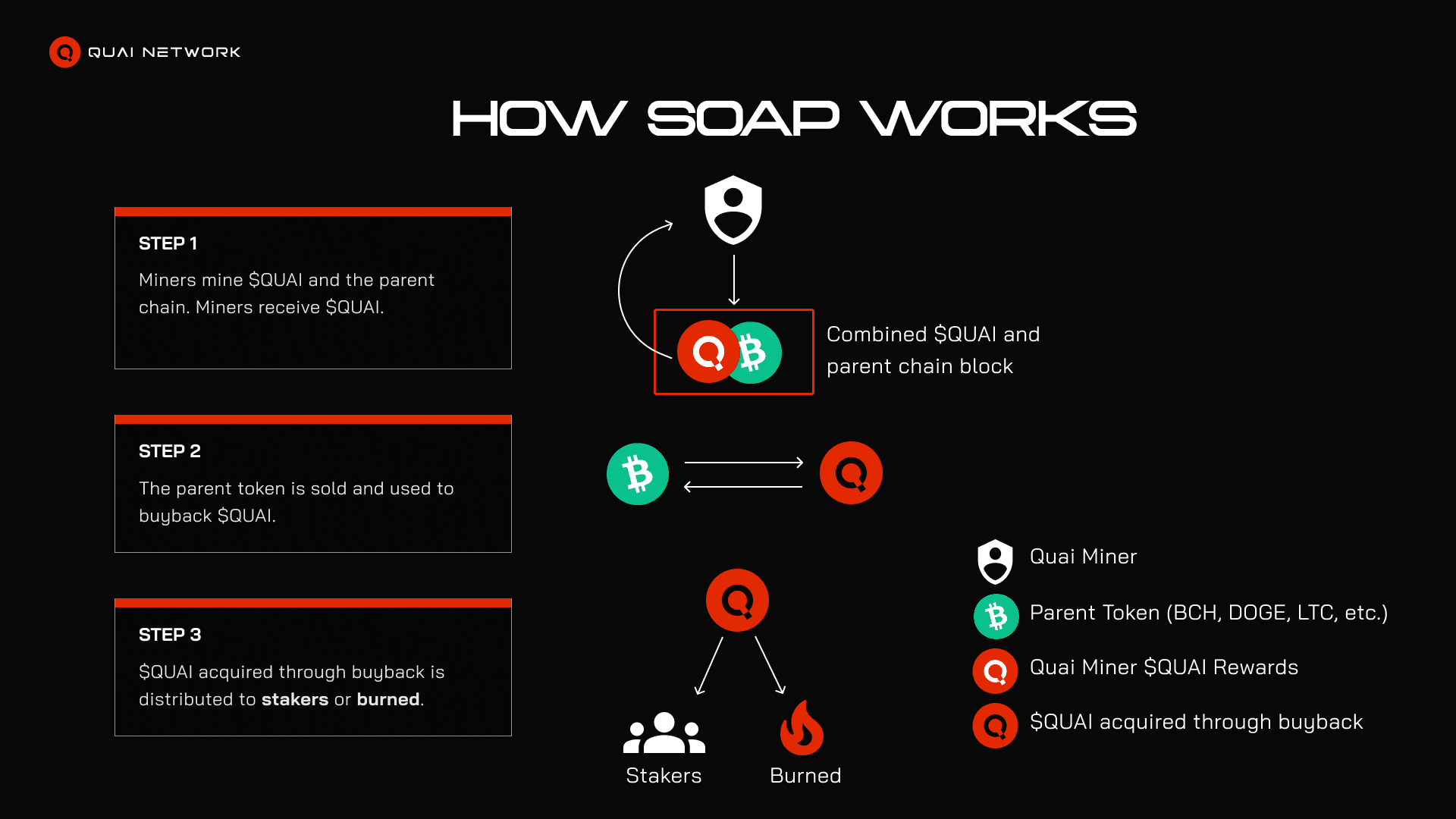
At block 1,530,500, the Singularity Fork permanently burned ~1.67 billion QUAI — 81% of all future genesis unlocks — through a multilateral agreement between investors, Dominant Strategies, and the Quai Foundation.
Project SOAP (Subsidized Open-market Acquisition Protocol) turns merged mining subsidies into continuous QUAI buybacks and burns. SHA, Scrypt, and KawPow miners — the same hardware securing Bitcoin, Litecoin, and Dogecoin — earn QUAI through workshares with zero additional energy.
Post-Singularity economics
QUAI has a soft cap near 1.4 billion tokens. Net protocol emissions approach zero over time as SOAP burns offset mining rewards. The monetary base is non-dilutive — a property shared by almost no other blockchain launched in the last decade.
How workshare mining works
Quai pays miners for workshares, not just blocks. Miners submit work proofs that fall below the full block difficulty threshold and receive proportional rewards. This Proportional Reward Splitting (PRS) mechanism achieves game-theoretic equilibrium — miners are always better off publishing work than withholding it.
GPU miners running SHA, Scrypt, or KawPow algorithms can participate alongside dedicated Quai miners, earning additional rewards from hardware they already operate.
How to Mine Quai
Quai supports three mining algorithms: KawPoW (GPU), SHA-256 (ASIC), and Scrypt (ASIC). The same hardware that mines Bitcoin, Litecoin, or Ravencoin can mine Quai with no extra energy — just point your miner at a pool.
Two steps to start mining
1. Create a Quai address with Pelagus or Tangem.
2. Point your miner at any Quai pool below.
Mining Pools
Why mine Quai instead of Bitcoin or Litecoin?
Through SOAP, Quai merged mining can be more profitable than mining Bitcoin, Bitcoin Cash, Litecoin, Dogecoin, or Ravencoin directly. Your existing hardware earns QUAI through workshares with zero additional energy cost — the same computation that mines other chains simultaneously mines Quai.
SOAP’s buyback mechanism also reduces sell pressure, meaning mined rewards hold value better over time compared to purely inflationary mining rewards.
Lock rewards for higher yields
Miners can lock their QUAI rewards for up to 12 months to earn enhanced yields — up to 25% APY. Locked rewards issue Liquid Mining Tokens (LMTs) that can be traded or used in DeFi while the underlying QUAI remains locked, giving miners both immediate liquidity and long-term upside.
Why Now
- Monetary expansion is accelerating. Global central banks have spent two decades normalizing emergency measures that erode purchasing power and reward borrowing over saving. U.S. national debt alone has surpassed $36 trillion.US Debt Clock
- CBDCs threaten financial privacy. Over 130 countries are developing Central Bank Digital Currencies that give governments direct visibility into every transaction. Programmable money means programmable restrictions — spending limits, expiry dates, and account freezes without due process. Decentralized money is the opt-out.
- Centralized stablecoins are permissioned money. USDC and USDT depend on banking relationships that regulators can sever at will. Circle has frozen funds at the U.S. Treasury’s direction. A stablecoin that can be frozen is not stable — it’s a permission slip.USDT Supply
- AI is driving explosive energy demand. Global data center power consumption is projected to double by 2030 as AI training and inference scale. Proof-of-Work mining absorbs surplus and stranded energy as a buyer of last resort — stabilizing grids, funding renewable buildout, and converting excess capacity into monetary security instead of waste.
- Government surveillance is expanding. Financial surveillance infrastructure — from Operation Choke Point 2.0 to cross-border reporting frameworks — is growing faster than the legal protections against it. Permissionless, energy-backed money exists outside these systems by design.
- Proof-of-Stake has centralized. Ethereum’s validator set is dominated by a handful of liquid staking providers. Lido alone controls over 28% of staked ETH. PoS concentrates power in the hands of the already-wealthy — the opposite of decentralization.
Quai mainnet launched January 29, 2025. The hierarchy is live. The Singularity Fork has already burned the insider allocations that plague other projects. Every component exists — now.
Peer-Reviewed Research
Quai is built on a foundation of published, peer-reviewed research spanning consensus mechanisms, reward allocation, and multi-chain coordination.
Team & Advisors
Quai was built by researchers and engineers from the University of Texas at Austin, Georgia Tech, Stanford, and Apple — with advisory from Stephen Wolfram (Wolfram Research) and Professor Cesare Fracassi (UT Austin Blockchain Initiative).